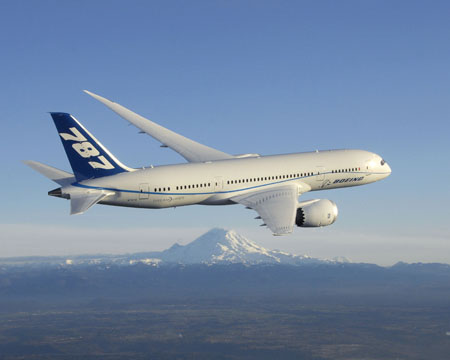
First Boeing 787 delivered to ANA
EVERETT, Wash., Sept. 26, 2011 /PRNewswire/ -- Boeing [NYSE: BA] celebrated the delivery of the first 787 Dreamliner today to launch customer ANA during a ceremony adjacent to the factory where the airplane was assembled. More than 500 employees representing the 787 program walked alongside the all-new jetliner to present it to ANA executives as a crowd of thousands looked on.
"Today we celebrate a significant moment in the history of flight," said Jim McNerney, Boeing chairman, president and CEO. "The 787 Dreamliner is the biggest innovation in commercial aviation since the Boeing 707 introduced the world to passenger jet travel more than 50 years ago. I want to thank ANA and all the employees of Boeing and our partner companies for the talent, technology and teamwork that have brought this game-changing airplane to life."
During the ceremony, Boeing Commercial Airplanes President and CEO Jim Albaugh presented a ceremonial key to Shinichiro Ito, president and CEO of ANA.
"It's not often that we have the chance to make history, do something big and bold that will change the world in untold ways and endure long after we are gone," said Albaugh. "That's what the 787 Dreamliner is and what ANA and Boeing have done together – build what truly is the first new airplane of the 21st century."
"We are delighted to be taking delivery finally of our first 787. ANA is extremely proud to be the launch customer for the Dreamliner and to have helped Boeing so closely in the development of this state-of-the-art aircraft," said Ito. "The Dreamliner will enable us to offer unrivalled standards of service and comfort to our passengers and will play a key part in ANA's plans for international expansion."
Made from composite materials, the Boeing 787 Dreamliner is the first mid-size airplane capable of flying long-range routes and will allow airlines to open new, non-stop routes preferred by the traveling public. In addition to providing airlines with unprecedented fuel economy and low operating costs, the 787 features a host of new technologies that greatly enhance the passenger experience.
"Today you join the ranks of the legends of our industry," said Pat Shanahan, Boeing Commercial Airplanes vice president and general manager, Airplane Programs. "I have no doubt that 30 or 40 years from now another outstanding Boeing team will be celebrating a new version of the 787 Dreamliner. They will struggle to find the words to express their deep respect and admiration for the hard work you have done in getting us to this day and laying the foundation for a strong future for Boeing and for our industry."
"I've been inspired by your passion, your commitment and your dedication. You made the 787 Dreamliner a reality," said Scott Fancher, Boeing Commercial Airplanes vice president and general manager, 787 program. "Your achievement we celebrate today is extraordinary, and it will be remembered for years to come."
ANA and Boeing completed the contractual delivery of the airplane on Sept. 25. ANA will fly the airplane to Tokyo Haneda Airport on Tuesday, with a scheduled departure of 6:35 a.m. (Pacific time) from Paine Field. A live webcast of the flyaway can be seen at www.newairplane.com. Video highlights of all 787 first delivery events also will be posted to the website.
Source: Boeing
Labels:
All Nippon Airways,
ANA,
Boeing 787,
first 787
First Boeing 787 to be delivered rolled out
Boeing rolled out the first 787 Dreamliner to be delivered to launch customer All Nippon Airways, decked out in the blue and white of the Japanese airline.
Boeing presented the plane to ANA executives and crew under clear skies at its Everett factory north of Seattle. The first domestic flights are set to start in Japan in September.
"The plane is being certified to the highest FAA standards," said Scott Fancher, vice president and general manager, 787 programme. "But the real focus of the travelling public will likely be on customer satisfaction and the elegance of the flight."
The 787 is a lightweight plane that promises 20 percent greater fuel efficiency to operators than similarly sized planes. Boeing says 50 percent of the primary structure will be made of composite materials instead of aluminium.
Aviation experts expect Boeing to apply the technology to future planes.
The interior of the first aircraft includes 264 seats -- 12 business and 252 economy -- with personal television sets, roomier seats, an automatic toilet with a wash function, more storage, an arched entry way with a beverage bar, dimmable windows and larger lavatories.
Boeing is about three years behind schedule in delivering the first 787 largely because of snags in the unusually complex global supply chain.
The 787 is almost finished with flight tests and is set for delivery to ANA in September.
Boeing has taken 827 orders for the Dreamliner, a record number for a Boeing plane still in development. ANA has ordered 55 of the planes that list for about USD$200 million.
Boeing is developing two versions of the Dreamliner. The first, the 787-8, will carry 210 to 250 passengers on routes of 7,650 to 8,200 nautical miles. A second version, the 787-9, will carry 250 to 290 passengers on routes of 8,000 to 8,500 nautical miles.
Boeing also has been talking about a third, larger variant, the 787-10, and says it is seeing strong airline interest in the plane.
Source: Reuters
Labels:
All Nippon Airways,
ANA,
BOEING,
Boeing 787
Boeing 787 certification
Boeing said on Monday it began incorporating required changes to its long-delayed 787 Dreamliner to move it toward certification this year by aviation authorities.
The work, to be done in San Antonio, Texas, includes installing electronic and mechanical equipment, software upgrades and testing systems.
A Boeing spokesman said the "change incorporation" step is required for all new aircraft. He said the company expects the plane to be certified this year.
Boeing said it will hire 450 temporary employees to join its staff of 1,700 workers based in San Antonio.
Boeing is nearly three years behind its original schedule for the lightweight, carbon-composite 787. The company expects first delivery in the third quarter of this year.
Source: Reuters
Labels:
Boeing 787,
certification
Boeing Completes 1,000th 787 Flight
EVERETT, Wash., Feb. 24, 2011 /PRNewswire/ -- The Boeing (NYSE: BA) 787 Dreamliner made its 1,000th flight yesterday, marking another milestone in the flight test program. There are seven airplanes participating in flight testing. The landing of 787 flight test airplane ZA004, just after 1 p.m. MST at Yuma International Airport in Arizona, counted as the official 1,000th flight.
The program is near its 3,000th hour of flying and 787s have flown a total of more than one million miles.
"The team is making great progress," said Scott Fancher, vice president and general manager of the 787 program. "We are getting through the test conditions needed to certify this airplane with nearly 80 percent of the conditions for the first model, with Rolls-Royce engines, already complete. And, we're more than 60 percent of the way through the test conditions for the 787s with General Electric engines."
Capt. Mike Carriker, chief pilot for the 787, Boeing Test & Evaluation, said the airplane continues to behave well in testing.
"We're really eager to get this airplane through its flight testing so our customers can see for themselves this airplane's excellent performance," said Carriker.
Pictured here, ZA004 frames Mt. Rainier in Western Washington during a test flight earlier this year.
Source: Boeing
Labels:
Boeing 787
50 Years of Malaysian Airport
It was a circular concrete landing ground 1,000 yards in diameter. It was bound by an open perimeter ditch and drained by a system of sub-soil drains. On the outside of the perimeter ditch, an annular space 200 yards wide provided extra clearance for aircraft rising from the landing ground.
This described Malaysia's first civilian airport in Bayan Lepas, Penang. It was built in 1932 at a cost of RM135,741. Three years later, it had full night landing facilities and a permanent hangar 100 feet square by 25 feet high was being built.
Penang replaced Alor Star as the transit stop for KLM and Imperial Airways that made it a port of call, where it served as the terminal port for the Penang-Hong Kong service. At the outbreak of the Second World War, Malaysia had 10 airstrips namely, Port Klang, Ipoh, Sitiawan, Taiping, Simpang Ampat, Batu Pahat, Kluang, Kota Baru, Kuching, and Bintilu.
In fact, Bintulu airport was listed in the Guiness Book of Records as the only airport in the world that is in the heart of the city. In 1933, Malaysia's first international aerodrome, the Sungai Besi Airfield, receiced its first international commercial aircraft.
The rapid growth in air transportation saw the airport expanded at a cost of RM590,000. The attap shed terminal was replaced with a new terminal as well as four hangars and a 6,200-feet tall weather runway.
In 1956, the airport was declared an international airport, marked by the flight of a turbo-propeller Bristol Britannia aircraft to Europe. By 1957, the country had two international airports and six domestic airports that recorded a total of 130,000 passengers.
Within two years of independence, the federal authorities came up with a blueprint for a brand new international airport for Kuala Lumpur to be located in Subang. Six years later in 1965, the RM52 million Subang International Airport was opened with facilities, amenities and accoutrements befitting a modern international airport.
Subang served as the main gateway to the country for the next 30 years, recording exponential passenger and cargo growth. It underwent several renovations and facility upgrade to meet the growing needs including the introduction of a primary radar for air traffic control, upgrading of the main terminal and expansion of the hangar.
At the same time, airport development projects were also carried out in other parts of the country such as Penang, Kota Bharu, Kuala Terengganu, Kota Kinabalu, Pulau Langkawi, Ipoh, Miri and Sibu.
The surge of airport development projects provided Malaysians the opportunity to acquire and upgrade their airport design and construction expertise. As a result, Malaysia developed a corps of specialists who could manage, plan, design and build airports of various sizes and scale. This reservoir of local specialists formed the bedrock of the KL International Airport (KLIA) development project. KLIA represented a giant leap in Malaysian civil aviation history.
It was the solution to the congestion experience in Subang Airport.In 1991, the government privatised the development of KLIA by forming Kuala Lumpur International Airport Berhad to undertake the project management of the new airport. In the same year, Parliament passed a bill that split the functions of the Department of Civil Aviation (DCA).
While DCA continue its role as the regulatory authority, a private company, Malaysia Airports Berhad took over the responsibility of operating, managing and maintaining the country's five international, 14 domestic and 15 Short Take-Off and Landing Ports (STOL Ports).
KLIA opened in 1998 as the result of a visionary strategy to meet the needs of new large aircraft and the traffic demand of the 21st century.
The award-winning airport is able to handle 25 million passengers per annum, and ultimately 100 million by the end of the next century.
A year later, Malaysia Airports became the first airport operating company to be listedbin Asia and the sixth in the world. The company was listed on the main board of Bursa Malaysia.
The core activities of the company include the management, operation and maintenance as well as development of airports with primary importance being placed on the operational efficiency, safety and security of passengers, cargo and aircraft operations.
Besides its core business activities, Malaysian Airports has in its corporate structure, a few subsidiary companies to offer a range of aviation and non-aviation-related products and services.
Malaysia Airports' present corporate structure includes 10 operating subsidiaries; Malaysia Airports Sdn. Bhd., Malaysia Airports (Sepang) Sdn. Bhd., Malaysia Airports (Niaga) Sdn. Bhd., Malaysia Airports Management & Technical Services Sdn., Sepang International Circuit Sdn. Bhd., Malaysia Airports Technologies Sdn. Bhd., Malaysia Airports (Properties) Sdn. Bhd., K.L Airport Hotel Sdn. Bhd., MAB Agriculture-Horticulture Sdn. Bhd. and Asia Pacific Auction Centre Sdn. Bhd. Its associated company is Urusan Teknologi Wawasan Sdn. Bhd. The Group has a total staff strength of over 7,000 deployed across 39 offices nationwide.
It is currently providing training for 238 personnel assigned to the new Hyderabad international Airport in India.
It is also part of a consortium that was awarded a contract for the restructuring and modernisation of the New Delhi Airport.
In April this year, it was awarded a 10-year contract to manage, operate and maintain the Astana International Airport in Kazakhstan under a trust management. Three months later, Malaysia Airports added another airport in its portfolio when it won the bid to manage Sabiha Gokcen International Airport, the second airport for Turkey.
The airport transportation industry is dynamic and airports are in a continuous state of flux with upgrading, expansion and maintenance works. Airports in Malaysia are no different. KLIA is nearing full capacity and a new satellite building is to be constructed soon.
A new dedicated low-cost carrier terminal was built at the KLIA, which now accommodates low-cost carriers operating to Malaysia.
The introduction of the Airbus A380 and Boeing 787 is expected to herald more changes in the design and operation of airports. The challenge to Malaysia Airports is to manage the expectations of the industry, stakeholders and the nation.
Source: Fauziah Ismail, A New Straits Times Special, August 31, 2007
Proven Ways to Make Money on the Internet
Subscribe to:
Posts (Atom)