I have been thinking this back and forth now quite some time. This idea is quite simple, the purpose is to fix the most critical problem with auto conversions, achieve better aerodynamics, propeller placement and mass and inertia distribution.
Auto conversions most often fail, no surprise, because of the reduction gear or belt. The core engine is not the root cause in the problems and many problems with the reduction belt or gear system can not be seen beforehand because the dynamics of the vibrations of the engine, propeller and their inertia forces affecting each other is a bit more complicated than one could think at first - it is not that simple to make these parts to last for hundreds or thousands of hours.
So we came up (with Kate, we usually talk with Kate about these things and we kind of invent these things together, I usually happen to be the one who writes them down - and it is usually so that Kate is the opponent into which I test my idea's feasibility before I write it here) with the idea of having a auto engine, possibly a diesel engine, running at constant power, most likely exactly at the optimum point of the engine, always. Then all the power variation would come from the electric motors which would drive the propellers. The idea is that the diesel engine only runs a generator.
The downside of this idea is the additional weight from the generator, batteries, motor controllers, electric motors and the props (depending how many electric motors are used, it is also possible to use just one if that is preferred). However, there are two several things possibly good about this:
- First the diesel engine burns less fuel, resulting smaller fuel tanks.
- Secondly the gearbox system is saved. The gearbox system can be very heavy duty in a high power aircraft engine and they still have tendency to fail. Possibly something like 40-50 kg is saved straight away.
- Thirdly the aerodynamic advantage - optimal aerodynamic shape without using long extension shafts and couplings to deal with the dynamics of the rotating shaft connected to a non-optimally rotating propeller and the power pulses of the diesel engine. Now there is the chance to put the engine anywhere in the airframe where it best fits and propeller drive don't need to be considered at all.
Then there is the redundancy thing. Brushless DC electric motors usually never fail, but the prop can still fail in bad circumstances. Therefore having two independent props for the one diesel engine could be advantageous. Same thing with the batteries - if the diesel engine fails, the batteries could be sized such that the aircraft can fly without the diesel engine for example for 30 minutes in level flight. That might be enough in most cases to get safely on the ground, except on middle of an ocean. The most likely place for the engine to fail is the takeoff. This takeoff stress would never happen with this engine configuration - the engine would be run always at optimum and safe power, never on takeoff power. The extra power for the takeoff can be easily taken from the batteries if they have proper capacity and the electric motors are powerful enough. On takeoff the batteries at full power are not discharging that quickly, because the diesel engine is recharging the batteries at the same time. The takeoff power can be rarely used for longer than 5 minutes on an aircraft equipped with Lycoming engine either, so having a limited period of time for the full power is not that big problem.
Generator and electric motor can have very high efficiency, and the gap to a efficiency of a reduction belt system is not that great. Best electric motors (though heavy ones) are around 98% efficient.
On descent the diesel engine could be shut down providing there was enough battery capacity. The motors could actually regenerate also batteries when the pilot wants to decelerate the plane.
Maintenance cost would be like a single engine aircraft, but the reliability geared towards a twin. Of course there is the one little fine print: the battery pack is expensive and it has an expiration time and date, unfortunately. But nothing is perfect and without compromises.
Any comments about this idea? This surely would not be a racer as the power to weight ratio would be rather poor, but anyhow I am thinking, providing it would be efficient enough to climb adequately, this would be a quite economical thing to fly and also easy conversion-wise, almost stock auto engine would be okay, no reduction gear and prop installation and an assembly that takes the push or pulling loads, would be needed. Also waiting on the airport would not waste any energy, since props can be completely stopped when the plane does not need to move. For example Lycoming IO-360 consumes about the same amount of gasoline per hour when waiting on IFR clearance on the ground than our Toyota Prius car on highway. Consuming zero amount of fuel when still on the ground, but still being ready, would save some liters.
And answer to the question, why diesel and not gasoline when gasoline engines can be run very lean and quite great specific fuel consumption values can be achieved in optimal conditions - it is quite simple: availability of the 100LL/Avgas seems to be becoming poor. There has been three 100LL operators in Finland, but two of them decided to discontinue this year. There is only one left. When that only one decides that it is not profitable enough, there is no 100LL available for anybody and the whole country's fleet of Lycoming and Continental based planes are grounded. The Jet-A1 is not going anywhere, so engine that can burn the jet fuel would be a safe bet. Jet engine, turboprop, or turbofan are out of the question because those are not available in meaningful sizes and power classes - there is not a small turbofan that would have high pressure ratio and bypass ratio available, nobody manufactures such a thing. And it is unlikely anybody will in the future because this personal flying all is a very niche market unfortunately until it changes for better (if it ever does).
The implementation possibilities have challenges; namely no such electric motor available (would require custom motors possibly), etc. And the weight also causes penalty for the efficiency and speed of the plane. But the power to weight ratio will be with this arrangement a lot better than on a pure electric aircraft. And pure electric aircraft is feasible, why an electric aircraft with a generator and a fueltank added would not be.
And by the way, even if it is first of April at the time of writing this, this blog post is not an April fool.
Idea: Helicopter with the blades extendeding from the outer edge of a lens shaped lifting body
I was today walking with a dog and it occurred to me that with a fly by wire system a helicopter which would have blades outside of a circular lifting body and that would have a pusher prop (cruise prop) on top of the said flat lifting body in a pivoting pylon with thrust vectoring, could possibly fly stable and avoid the not that good things of a helicopter and be more efficient VTOL craft than a conventional helicopter. The bearing on the outer ring would possibly though be some sort of a challenge. On a big one, the outer ring could be not connected to the inner ring at all, but it could actually use maglev technique to levitate in a hole without physical contact with the bearing. This could come with too heavy weight penalties, so not sure if it would be feasible. So this is just a out of the box thinking idea because I have always felt that there is something wrong with helicopters, I have never really liked how they look like and how they function, there must be a better way to do that.
Cyclic system could be hidden inside the center section so that it would not cause drag like on a helicopter where there are lots of mechanical parts directly in the airflow causing drag. In cruise the plane would be a gyrocopter rather than a helicopter because it would have positive angle of attack unlike helicopter which cruises at negative angle of attack (and only blades have positive angle of attack).
I would like to try this as RC-model, but the challenge would be to fabricate such a large and yet lightweight bearing that would be size of the craft itself. The outer shell with the bearing would have a gear tooth that would be driven with a pinion gear that would be connected to the engine. This would also function as gear reduction drive. In addition to the ring drive to takeoff and landing, there would need to be a generator for driving the pylon mounted thrust vectoring prop that would be run with an electric motor.
The shape of the lifting body would be a suboptimal airfoil because it would need to be symmetrical and have both sharp leading edge and trailing edge but. This kind of craft would be naturally unstable but it could be artificially stabilized with software.

Cross sections in Rhino from a loft
I wrote a long time ago about how to do cross sections in Rhino. I mentioned that it needs to be Object intersection. If you do Boolean Intersection, this technique is not going to work. I found that the earlier instruction might have been a bit confusing because there are multiple ways to do intersections in Rhino.
The original article is here: http://design-plane.blogspot.com/2020/10/irhino-learnings-of-today.htmlPlease read it.
The function what you have to use is Intersect (to do Object Intersection).
If you type it to the command area, type Intersect, not Intersection or Booleanintersection.
You know that you have chosen wrong intersection method if you have to select two set of objects. Multiselect everything (your cutters and the lofted surface) at the same time and do Intersect. It works.
The original article is here: http://design-plane.blogspot.com/2020/10/irhino-learnings-of-today.htmlPlease read it.
The function what you have to use is Intersect (to do Object Intersection).
If you type it to the command area, type Intersect, not Intersection or Booleanintersection.
You know that you have chosen wrong intersection method if you have to select two set of objects. Multiselect everything (your cutters and the lofted surface) at the same time and do Intersect. It works.
Rutan Proteus photo collection
NASA has nice photo collection. If you like the looks of the Proteus (in my opinion it is one of the most beautiful aircraft ever done), have a look:
http://www.dfrc.nasa.gov/gallery/photo/Proteus/index.html
http://www.dfrc.nasa.gov/gallery/photo/Proteus/index.html
Airplane design from structural efficiency point of view combined with aerodynamics point of view - multi-domain optimization
So far I have been looking only the aerodynamics side, but it is quite evident that compromises are needed on the aerodynamics side to achieve the best structural efficiency. I think one good example is Virgin Global Flyer (Scaled Composites model 311). I have not analysed yet the structure, but common sense says that trimaran has weight placed more evenly along the wing span avoiding a very large point load in the middle where the single fuselage would normally exist. The trimaran may have more wetted area than a single fuselage, but on the other hand, weight savings in the very high aspect ratio wing and space gains for the extra fuel are in this concept very important factors.
I find the trimaran configuration quite interesting - several different engine placement configurations for example can be used with this configuration without changing the aerodynamic shape of the concept very much. It is also interesting because it allows placement of the main gear away from the center fuselage and thus provides greater stability on the ground when the aspect ratio is high even if there is fuel placed to the wings very far away from the center of gravity. And as can be seen the same design suits several different missions: Global Flyer is very much like White Knight 2 with SpaceShipTwo under it on the center. Almost the same configuration, adapted to different kind of mission for very different kind of parameters (Global Flyer = long range cruise, White Knight 2 = optimized for climb).
Global flyer drawing Google found from some site
Wikipedia has another great photo, this is from front
The configuration is not really so new and not so unproven either, as people might expect, here is one example where a similar configuration has been used a long time ago:
Northrop Widow
The only difference here is that the Northrop Widow was optimized for different mission than either of the abovementioned and that it had piston engines in front of the outer "fuselages" which were interconnected from the tail section similarly than in Adam A500 whereas the Global Flyer and White Knight Two have two separate tails. It is quite apparent why the tails are separate in these aircraft - because the outer fuselages are placed so widely apart from each other, connecting the tails would have made the tail unnecessarily large which would have caused negative effect for the drag despite it would have had fewer intersections. On the other hand, I have been looking different HALE concepts, and it is quite apparent that the number of intersections is not the major drag source in high altitude aircraft, but the induced drag is, and to minimize induced drag, more intersections can be allowed as the penalty from them is lesser than limiting the aspect ratio would be. This is why there are even some concepts considered at the moment which have wing struts - even if everybody knows that they produce drag, in some concepts, the significance of that drag can be proportionally small whereas the increased aspect ratio has major effect on minimizing the total drag of the aircraft. HALE aircraft have to be quite different than those which are designed to cruise at low altitude, the drag percentages of each contributors are quite different and "one size does not fit all".
It is quite interesting area to explore when the structural efficiency is added to the equation in addition to the aerodynamics and the result is a compromise on both structures and aerodynamics instead of being optimized for either aerodynamics or for structures. The mission parameters tend to heavily affect both and best suited results can be achieved by combining these two and by knowing the intended use exactly, potentially bigger gains can be realized than in a concept that is a general purpose in everything (GA = GENERAL aviation).

I find the trimaran configuration quite interesting - several different engine placement configurations for example can be used with this configuration without changing the aerodynamic shape of the concept very much. It is also interesting because it allows placement of the main gear away from the center fuselage and thus provides greater stability on the ground when the aspect ratio is high even if there is fuel placed to the wings very far away from the center of gravity. And as can be seen the same design suits several different missions: Global Flyer is very much like White Knight 2 with SpaceShipTwo under it on the center. Almost the same configuration, adapted to different kind of mission for very different kind of parameters (Global Flyer = long range cruise, White Knight 2 = optimized for climb).
Global flyer drawing Google found from some site

Wikipedia has another great photo, this is from front

The configuration is not really so new and not so unproven either, as people might expect, here is one example where a similar configuration has been used a long time ago:
Northrop Widow
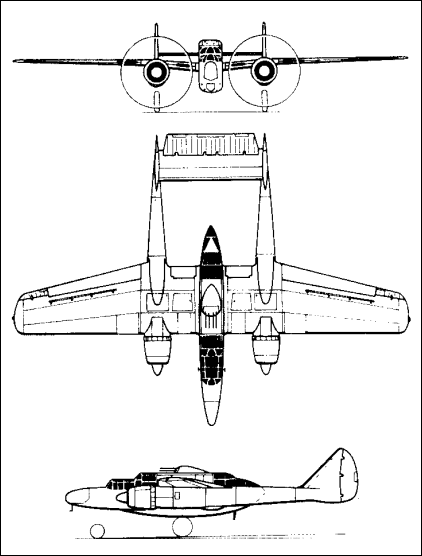
The only difference here is that the Northrop Widow was optimized for different mission than either of the abovementioned and that it had piston engines in front of the outer "fuselages" which were interconnected from the tail section similarly than in Adam A500 whereas the Global Flyer and White Knight Two have two separate tails. It is quite apparent why the tails are separate in these aircraft - because the outer fuselages are placed so widely apart from each other, connecting the tails would have made the tail unnecessarily large which would have caused negative effect for the drag despite it would have had fewer intersections. On the other hand, I have been looking different HALE concepts, and it is quite apparent that the number of intersections is not the major drag source in high altitude aircraft, but the induced drag is, and to minimize induced drag, more intersections can be allowed as the penalty from them is lesser than limiting the aspect ratio would be. This is why there are even some concepts considered at the moment which have wing struts - even if everybody knows that they produce drag, in some concepts, the significance of that drag can be proportionally small whereas the increased aspect ratio has major effect on minimizing the total drag of the aircraft. HALE aircraft have to be quite different than those which are designed to cruise at low altitude, the drag percentages of each contributors are quite different and "one size does not fit all".
It is quite interesting area to explore when the structural efficiency is added to the equation in addition to the aerodynamics and the result is a compromise on both structures and aerodynamics instead of being optimized for either aerodynamics or for structures. The mission parameters tend to heavily affect both and best suited results can be achieved by combining these two and by knowing the intended use exactly, potentially bigger gains can be realized than in a concept that is a general purpose in everything (GA = GENERAL aviation).
Austin's jet design
x-plane.com website had looked a bit boring lately, Austin's long and interesting changelogs are hidden deep under the menu structure, looks like a design of a web designer lately.
But luckily yesterday I realized that Austin had added a link on top of the page. Small link on top of the web designer blob and that goes directly into an interesting page. Now today there are two links (as there is 9.50 beta for X-plane available too), but this one was particularly interesting in the topic of this blog: The Laminar Research X-1 Cavallo is conceived
But luckily yesterday I realized that Austin had added a link on top of the page. Small link on top of the web designer blob and that goes directly into an interesting page. Now today there are two links (as there is 9.50 beta for X-plane available too), but this one was particularly interesting in the topic of this blog: The Laminar Research X-1 Cavallo is conceived
Why Diamond uses Wortmann FX63-137?
I have been thinking over and over again why Diamond has chosen the Wortmann high lift airfoil FX63-137 on its aircraft. However, I am suspecting what might be the reason (not confirmed though since anybody on Diamond booth e.g. in Oshkosh is usually never able to answer to my questions). Here is my theory about it:
- The FX63-137 has high L/D at fairly high alpha and thus Cl (as the airfoil is such that the Cl rises rapidly as a function of alpha). This is maybe not the best configuration for cruise where a low drag bucket at low Cl is desirable. On an airfoil which has best L/D at low Cl, the climb has more D component (because high lift devices cause drag) and while getting more L with high lift devices. It might be close to the optimal climb optimisation on the chosen aspect ratio on those planes and compromise is drawn to cruise and it is not seen as a bad thing because competition is not faster but usually slower, it does not take so much to win e.g. a C172 in efficiency and speed after all. So it might be that with a lower drag cruise airfoil e.g. DA42NG with the very heavy diesel engines might have somewhat poorer climb rate on single engine situation or it might not climb alltogether if the airfoil was not optimised to provide low drag on high Cl.
- Comparison between the DA40 and Cirrus SR20 kind of potentially shows this: the Diamond shows significantly better climb rates with a quite similar AR and quite similar wing loading (SR20 takes some toll on that, but not that much in comparison if a light loaded SR20 and heavy loaded DA40 is compared), despite of the fact that the SR20 has more sophisticated flaps and the SR20 has 20 hp more engine power available.
- This can be also evidenced on best climb rate speed: with similar wing loading, the best climb rate speed is much higher on the SR20 than it is on the DA40, which partly indicates that the sweet point in the L/D occurs at lower alpha on SR20 than on DA40. SR20 also requires quite accurate angle of attack and thus speed to climb optimally whereas the DA40 is not that critical which would also indicate that the low drag bucket of the FX63-137 is broader than on the (according to UIUC data site) Roncz airfoil on the SR20.
So this is just my home-brewn theory style thinking, is based on collected information and my experience with flying the Diamond DA40, DA42 and Cirrus SR20 and SR22. I might be wrong as always, but here is some food of thought if you have been thinking why there is this airfoil with high L/D at high Cl and the airfoil also has fairly high pitching moment which some find undesirable because of for example trim drag.
- The FX63-137 has high L/D at fairly high alpha and thus Cl (as the airfoil is such that the Cl rises rapidly as a function of alpha). This is maybe not the best configuration for cruise where a low drag bucket at low Cl is desirable. On an airfoil which has best L/D at low Cl, the climb has more D component (because high lift devices cause drag) and while getting more L with high lift devices. It might be close to the optimal climb optimisation on the chosen aspect ratio on those planes and compromise is drawn to cruise and it is not seen as a bad thing because competition is not faster but usually slower, it does not take so much to win e.g. a C172 in efficiency and speed after all. So it might be that with a lower drag cruise airfoil e.g. DA42NG with the very heavy diesel engines might have somewhat poorer climb rate on single engine situation or it might not climb alltogether if the airfoil was not optimised to provide low drag on high Cl.
- Comparison between the DA40 and Cirrus SR20 kind of potentially shows this: the Diamond shows significantly better climb rates with a quite similar AR and quite similar wing loading (SR20 takes some toll on that, but not that much in comparison if a light loaded SR20 and heavy loaded DA40 is compared), despite of the fact that the SR20 has more sophisticated flaps and the SR20 has 20 hp more engine power available.
- This can be also evidenced on best climb rate speed: with similar wing loading, the best climb rate speed is much higher on the SR20 than it is on the DA40, which partly indicates that the sweet point in the L/D occurs at lower alpha on SR20 than on DA40. SR20 also requires quite accurate angle of attack and thus speed to climb optimally whereas the DA40 is not that critical which would also indicate that the low drag bucket of the FX63-137 is broader than on the (according to UIUC data site) Roncz airfoil on the SR20.
So this is just my home-brewn theory style thinking, is based on collected information and my experience with flying the Diamond DA40, DA42 and Cirrus SR20 and SR22. I might be wrong as always, but here is some food of thought if you have been thinking why there is this airfoil with high L/D at high Cl and the airfoil also has fairly high pitching moment which some find undesirable because of for example trim drag.
Subscribe to:
Posts (Atom)