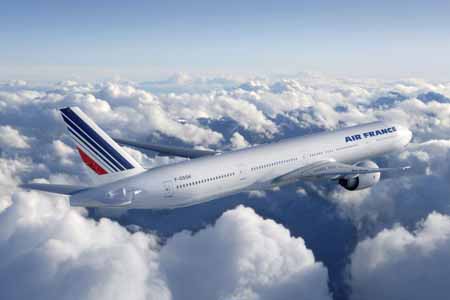
Strikes force Air France to cancel flights


Air France has seen approximately 15 per cent of its planned departures cancelled today as a strike by cabin crew continues to cause disruption.

Several unions walked out on Saturday as part of five days of action in protest against changes in working conditions.

The strike is expected to continue until Wednesday November 2nd.

Flight schedules have been reduced for the duration with Air France warning it could not rule out the possibility of “on the spot” cancellations.

Cabin crew, who called the strike during the middle of the half-term holidays in France, have been angered by a plan to reduce staffing on long-haul trips.

Government minister Nathalie Kosciusko-Morizet has publicly criticised the unions, primarily over the timing.

“Air France is in a delicate position,” she told Europe 1 radio in an interview, with the carrier expected to release financial results on November 9th.

Passengers have also been angered by planes appearing to run with empty seats despite the strike.

Air France explained that to keep as many planes in the air as possible short-haul flights were being limited to 100 passengers so flight stewards numbers stayed within safety limits.

Source: BTN

Air France comments on AF447 tragedy


On the eve of second anniversary of Air France’s Flight 447 tragedy, Air France has issued a statement saying that the carrier and its staff are turning their thoughts to the families of the passengers and crew who were aboard the fight to wish to express their full solidarity. The aircraft crashed over the Atlantic Ocean on a flight from Rio de Janeiro to Paris

According to the statement, the perserverance of the authorities, Airbus and Air France has led to the flight recorders and parts of the aircraft being found after a two-year search. The French Accident Investigation Bureau (BEA) is now able to reveal the sequence of events leading to the crash of flight AF447 from Rio to Paris on 1 June 2009.
This description of the facts therefore replaces the assumptions that have been made over the past two years.
Air France said it appears that the flight deck crew was monitoring the changing weather conditions and thus altered the flight path, that the initial problem was the failure of the speed probes which led to the disconnection of the autopilot and the loss of the associated piloting protection systems, and that the aircraft stalled at high altitude. It also appears that the flight captain quickly interrupted his rest period to regain the cockpit. The crew, made up of three skilled pilots, demonstrated a totally professional attitude and were committed to carrying out their task to the very end and Air France wishes to pay tribute to them.
Air France stated that all the data collected must now be analyzed. It will only be at the end of this complex task, which requires patience and precision, that the BEA will be able to establish the causes that led to the disaster.
We can already see that the authorities, the manufacturer and the airline have taken measures to avoid the repetition of such an accident.
Air France hopes that everyone has the patience to wait for the interim report that the BEA will publish in a few weeks, no doubt along with additional recommendations. The safety of the global air transport industry will be even stronger.

Source: BTN

Air France Crash-Search Closer to Black Boxes as Tail Found


Flight recorders that could reveal why an Air France plane crashed into the Atlantic Ocean in 2009 killing 228 people are closer to being retrieved after a diving robot found the section of fuselage where they were mounted.
The tail from the Airbus SAS A330-200 jetliner has been discovered, Nelson Marinho, president of an association for families of the crash victims, said today in a phone interview from Paris after meeting yesterday with Jean-Paul Troadec, director of the BEA, France’s air-accident investigator.
The recorders themselves haven’t yet been found, BEA spokeswoman Martine Del Bono said today. Known as black boxes, the devices store detailed technical information and records of cockpit conversations and are designed to survive heavy impacts.
Debris from Air France Flight 447 was located at a depth of 3,900 meters (12,800 feet) earlier this month after a fourth search attempt. The A330 went down on June 1, 2009, after departing Rio de Janeiro for Paris Charles de Gaulle airport.
Another search vessel will leave Senegal on April 21 to head for the site, French Transport Minister Thierry Mariani said yesterday in a statement. Attempts will also be made to recover bodies that have been sighted with the wreckage.
The discovery of the A330 fragments renews hopes that the cause of the crash will be found, Air France-KLM Group Chief Executive Officer Pierre-Henri Gourgeon said on April 3. Both Air France and Airbus have been charged with manslaughter over the accident, the worst in the Paris-based carrier’s history.
Speed Sensors
The BEA has said a contributing factor may have been the icing up of speed sensors, or Pitot tubes, causing unreliable readings. The agency made the suggestion after reviewing data transmitted in the last minutes before the crash.
At least 13,000 photos have been taken of the debris zone, which includes an engine, the fuselage and pieces of wing and landing gear. None of the images gives an initial explanation of why the A330 fell from the sky, according to BEA chief investigator Alain Bouillard, who will lead the recovery effort.
The wreckage is spread over a flat and sandy zone north of the plane’s last known position, Troadec has said. Recorders of the type used on the A330 have never spent so long at depth, he said, raising uncertainty that they will still be readable.

Wreckage and bodies of Air France 447 flight found


Parts of the wreckage of an Air France plane found in the Atlantic at the weekend contain the bodies of some of the passengers who died when the aircraft crashed off Brazil in 2009, the French government said on Monday.


Air France flight 447, an Airbus A330 plane, crashed into the ocean en route from Rio to Paris, killing all 228 passengers and crew on board and a long search has so far failed to find flight recorders that could give clues to the cause of the accident.
The latest search, the fourth since the crash, is being carried out using a salvage vessel equipped with unmanned submarines. An initial underwater search had also found parts of wreckage and bodies.
France's BEA accident investigation authority said on Sunday it had found a large part of the plane's wreckage including the engine and parts of the fuselage, and Environment Minister Nathalie Kosciusko-Morizet said on Monday there were human remains inside.
"We have more than just traces, we have bodies... Identification is possible," she told France Inter radio.
Transport Minister Thierry Mariani said victims' families would be informed of the findings at a meeting at the end of the week and no further details would be made public before then.
"It's true that bodies have been seen, but given the sensitive nature of the subject we prefer to keep certain details for the families," he told France Info radio.
The discovery of the chunks of the Air France wreckage in a vast search radius of some 10,000 square km, has raised hopes that the aircraft's flight recorders, or black boxes, might now be found.
The aircraft vanished after hitting stormy weather over the Atlantic a few hours into the flight. Speculation about what caused the accident has focused on the possible icing up of the aircraft's speed sensors, which seemed to give inconsistent readings before communication was lost.

Source: Reuters

Air France

air france
air france
air france
air france
air france
air france
air france
air france

Air France Facebook page: 60 airline tickets to win to the destination of your choice!


Until Wednesday 9 March 2011, Air France Facebook page fans are invited to play a new game*, ‘Travel Challenge’, with an exceptional competition prize of 60 airline tickets to be won to the destination of their choice!
The principle is very simple: every day, on the ‘Travel Challenge’ page, fans discover the ‘photo of the day’ and link the photo to a city or the corresponding place from three possible choices. To increase their daily chances of winning, fans can invite their friends to join the
Air France Facebook page; if one of the winning entrants is a sponsored entrant, their sponsor will also be declared a winner. Prize winners shall be designated by an electronic prize draw carried out at 
8pm (Paris time) each day and immediately informed that they have won by email via their Facebook account and their names will also be published on the Air France page.
The competition prize comprises 30 prizes of two round-trip tickets in Voyageur (economy) class valid on all Air France routes**. 
Launched in July 2010, the Air France Facebook page currently has close to
170,000 fans who are mostly non-French. Thanks to this ‘Travel Challenge’ game posted since 23 February, Air 
France has more than doubled its number of fans in less than a week!  
In addition to competitions (last month, a 5-day trip to New York was won), Air France invites fans to discover airline news and behind-the-scenes footage from a novel angle. With some twenty videos and more than a thousand photos, the Air France Facebook page is the place to be for the airline’s most avid fans and aviation enthusiasts. With its video chats (new Premium Voyageur offer) or its fun posts (guess the name of a future destination served by the airline), Air France is directly interacting with its customers via several dozens of daily exchanges.     
*  free competition, with no obligation to purchase, rules of competition available on facebook.com/airfrance** with the exception of Papeete and only operated by Air France aircraft

Source: Air France

Air France-KLM/Delta mull Virgin Atlantic acquisition


Air France-KLM of Europe has teamed up with United States-based Delta Air Lines to consider a bid for Virgin Atlantic.
Owner Richard Branson is presently considering his options for the carrier in an increasingly competitive market.
Deutsche Bank has been appointed to examine strategic options, with a sale of Branson’s 51 per cent stake now a growing possibility.
Singapore Airlines holds the remaining shares in Virgin Atlantic after buying a 49 per cent share for £600 million in 1999.
Air France-KLM and Delta – already partners as part of the SkyTeam Alliance – are believed to be among the frontrunners for any deal.
Any deal would cost between £700 million and £1 billion, with Virgin Atlantic’s key landing slots at Heathrow central to any deal. 
Global Consolidation
Delta Air Lines recently lost its position as the biggest airline in the United States following the merger of United and Continental Airlines.
The move is part of a growing global consolidation trend.
In Europe British Airways recently merged with Iberia of Spain in a £5.2 billion deal to create International Airline Group (IAG).
Branson was public in his opposition to the deal and its eventual success may have prompted his decision to sell.
IAG has also secured a partnership with American Airlines on lucrative transatlantic routes, further squeezing Virgin Atlantic.
Etihad – recognised by the World Travel Awards as the World’s Leading Airline - is also thought to be interested in buying Sir Richard’s stake.
Chief executive James Hogan has written to Deutsche Bank to express an interest in a potential deal.
Etihad - the carrier owned by the ruling family of Abu Dhabi - has hired Bank of America Merrill Lynch to advise it.
Last year Air France and Delta joined to invest £1.3 billion in Japan Airlines, the ailing Asian carrier.
Japan rejected the approach in favour of remaining in the Oneworld airline alliance with American Airlines and British Airways.

Source: BTN

Blog Archive