There is lots of strong feelings about tractor vs. pusher propeller configuration but no exact generic answer. Here is one article about the topic. Does not make definitive answer, but gives some background for the topic:
http://www.flyingmag.com/technicalities/1582/pusher-pusher.html
Here is another article:
http://dic.academic.ru/dic.nsf/enwiki/514042
Forum discussion
Another forum discussion
http://www.aiaa.org/content.cfm?pageid=406&gTable=mtgpaper&gID=50663
Tractor (prop forward of laminar flow wing):
http://www.aiaa.org/content.cfm?pageid=406&gTable=Paper&gID=1248
Tractor propeller effect on wing behind the prop
http://adsabs.harvard.edu/abs/1987PhDT........47H
ctn.cvut.cz/ap/download.php?id=178
http://yarchive.net/mil/laminar_flow.html
http://search.informit.com.au/documentSummary;dn=384807529637512;res=IELENG
ctn.cvut.cz/ap/download.php?id=178
http://yarchive.net/mil/laminar_flow.html
http://search.informit.com.au/documentSummary;dn=384807529637512;res=IELENG

Propeller design rethought
Most manufacturers design propellers in the same way and they read the old books and reports and the prop gets no more than 80-85% efficiency at best. It is written in books that propeller efficiency will be about that at best and it is left often open how low it can be at worst.
Here is an interesting article about a guy that made a prop that was 90 percent efficient by not abiding the "old truths" but thinking out of the box:
http://www.eaa.org/experimenter/articles/2020-02_elippse.asp
Having a strong taper certainly makes sense since the propeller tip travels very much faster than the root through the air. Also the old saying that single blade prop is most efficient does not make sense if you think it in detail: the air that enters in the next blade is not the same air that went through the previous blade because of the forward movement of the aircraft. This could be extrapolated in a such way, that the faster the aircraft travels, the more blades the propeller can have without sacrificing the propeller efficiency. This should not actually require very high mathematics, but I am quite sure that it could be estimated with simple calculations where the downwash of the previous blade goes in relation to the next blade on the speed range intended for the aircraft being designed.
High altitude propeller will require some additional thinking for the tip chord because the Reynolds number will become low if the chord is this short. The TAS is much higher at high altitude, therefore the air travels faster through the prop, that would mean that the prop could have more blades. The high altitude propeller does not require full efficiency at low altitude because to be able to operate at high altitude, there needs to be a lots of excess thrust available regardless.
Here is an interesting article about a guy that made a prop that was 90 percent efficient by not abiding the "old truths" but thinking out of the box:
http://www.eaa.org/experimenter/articles/2020-02_elippse.asp
Having a strong taper certainly makes sense since the propeller tip travels very much faster than the root through the air. Also the old saying that single blade prop is most efficient does not make sense if you think it in detail: the air that enters in the next blade is not the same air that went through the previous blade because of the forward movement of the aircraft. This could be extrapolated in a such way, that the faster the aircraft travels, the more blades the propeller can have without sacrificing the propeller efficiency. This should not actually require very high mathematics, but I am quite sure that it could be estimated with simple calculations where the downwash of the previous blade goes in relation to the next blade on the speed range intended for the aircraft being designed.
High altitude propeller will require some additional thinking for the tip chord because the Reynolds number will become low if the chord is this short. The TAS is much higher at high altitude, therefore the air travels faster through the prop, that would mean that the prop could have more blades. The high altitude propeller does not require full efficiency at low altitude because to be able to operate at high altitude, there needs to be a lots of excess thrust available regardless.
Cheap Sharper Image Cessna 182 Pro Series Tri-Bladed Propeller (1) Outlet

- Sharper Image Cessna 182 Pro Series Tri-Bladed Propeller (1)
>>Click to See Best Deals!<<
Get best deals of Sharper Image Cessna 182 Pro Series Tri-Bladed Propeller (1) and it will be sold our from our stock very quick!
Deals on Sharper Image Cessna 182 Pro Series Tri-Bladed Propeller (1) has ONLY FEW ITEMS LEFT!
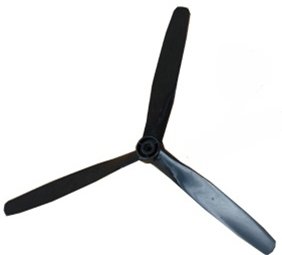

Get BestBuy Price of Sharper Image Cessna 182 Pro Series Tri-Bladed Propeller (1) now!
Specification:
Sharper Image Cessna 182 Pro Series Tri-Bladed Propeller (1)
- 1 Tri-Bladed Propeller!!
For Now. We offers you a nice variety associated with Sharper Image Cessna 182 Pro Series Tri-Bladed Propeller (1) with fast and Free delivery upon eligible purchases. This online shop are generally in associated with various dealers to save your time and efforts on seeking for Sharper Image Cessna 182 Pro Series Tri-Bladed Propeller (1) for the lowest price levels. Black Friday Price for Sharper Image Cessna 182 Pro Series Tri-Bladed Propeller (1) is a special price and time-limied.
All data as of Mar 02, 2012 22:14:04.
Low-cost Guillows 4" Plastic Propeller for Electric Planes Outlet

- Guillows 4" Plastic Propeller for Electric Planes
>>Click to See Best Deals!<<
Get low prices of Guillows 4" Plastic Propeller for Electric Planes and it will be out of stock realy quick.
Deals on Guillows 4" Plastic Propeller for Electric Planes has ONLY FEW ITEMS LEFT!
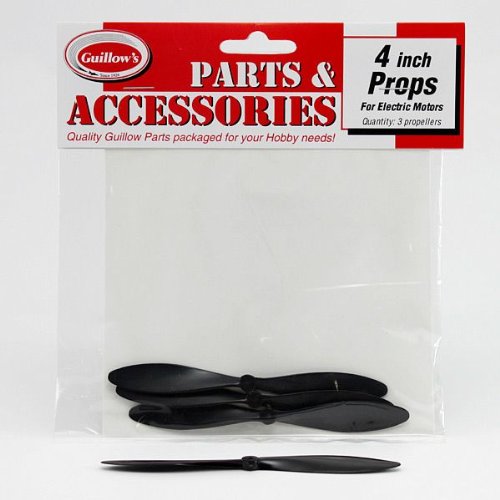
Get Low Price on Market of Guillows 4" Plastic Propeller for Electric Planes now!
For This Month. We offers you a nice wide range associated with Guillows 4" Plastic Propeller for Electric Planes with quality and FREE shipping upon qualified items. All of our web store have been cooperated with various dealers in order to save your time in searching for Guillows 4" Plastic Propeller for Electric Planes for the most affordable price levels. Black Friday Price for Guillows 4" Plastic Propeller for Electric Planes is a special price and time-limied.
All data as of Feb 29, 2012 17:57:41.
Propeller design rethought
Most manufacturers design propellers in the same way and they read the old books and reports and the prop gets no more than 80-85% efficiency at best. It is written in books that propeller efficiency will be about that at best and it is left often open how low it can be at worst.
Here is an interesting article about a guy that made a prop that was 90 percent efficient by not abiding the "old truths" but thinking out of the box:
http://www.eaa.org/experimenter/articles/2009-02_elippse.asp
Having a strong taper certainly makes sense since the propeller tip travels very much faster than the root through the air. Also the old saying that single blade prop is most efficient does not make sense if you think it in detail: the air that enters in the next blade is not the same air that went through the previous blade because of the forward movement of the aircraft. This could be extrapolated in a such way, that the faster the aircraft travels, the more blades the propeller can have without sacrificing the propeller efficiency. This should not actually require very high mathematics, but I am quite sure that it could be estimated with simple calculations where the downwash of the previous blade goes in relation to the next blade on the speed range intended for the aircraft being designed.
High altitude propeller will require some additional thinking for the tip chord because the Reynolds number will become low if the chord is this short. The TAS is much higher at high altitude, therefore the air travels faster through the prop, that would mean that the prop could have more blades. The high altitude propeller does not require full efficiency at low altitude because to be able to operate at high altitude, there needs to be a lots of excess thrust available regardless.
Here is an interesting article about a guy that made a prop that was 90 percent efficient by not abiding the "old truths" but thinking out of the box:
http://www.eaa.org/experimenter/articles/2009-02_elippse.asp
Having a strong taper certainly makes sense since the propeller tip travels very much faster than the root through the air. Also the old saying that single blade prop is most efficient does not make sense if you think it in detail: the air that enters in the next blade is not the same air that went through the previous blade because of the forward movement of the aircraft. This could be extrapolated in a such way, that the faster the aircraft travels, the more blades the propeller can have without sacrificing the propeller efficiency. This should not actually require very high mathematics, but I am quite sure that it could be estimated with simple calculations where the downwash of the previous blade goes in relation to the next blade on the speed range intended for the aircraft being designed.
High altitude propeller will require some additional thinking for the tip chord because the Reynolds number will become low if the chord is this short. The TAS is much higher at high altitude, therefore the air travels faster through the prop, that would mean that the prop could have more blades. The high altitude propeller does not require full efficiency at low altitude because to be able to operate at high altitude, there needs to be a lots of excess thrust available regardless.
Tractor vs. pusher
There is lots of strong feelings about tractor vs. pusher propeller configuration but no exact generic answer. Here is one article about the topic. Does not make definitive answer, but gives some background for the topic:
http://www.flyingmag.com/technicalities/1582/pusher-pusher.html
Here is another article:
http://dic.academic.ru/dic.nsf/enwiki/514042
Forum discussion
Another forum discussion
http://www.aiaa.org/content.cfm?pageid=406&gTable=mtgpaper&gID=50663
Tractor (prop forward of laminar flow wing):
http://www.aiaa.org/content.cfm?pageid=406&gTable=Paper&gID=1248
http://www.flyingmag.com/technicalities/1582/pusher-pusher.html
Here is another article:
http://dic.academic.ru/dic.nsf/enwiki/514042
Forum discussion
Another forum discussion
http://www.aiaa.org/content.cfm?pageid=406&gTable=mtgpaper&gID=50663
Tractor (prop forward of laminar flow wing):
http://www.aiaa.org/content.cfm?pageid=406&gTable=Paper&gID=1248
Subscribe to:
Posts (Atom)